
Recent Observations of Deity
Perceptions of Alleged Divine Phenomena.
1. Introduction
Why People Still Report Divine Phenomena.
Many people across the world continue to report experiences that they interpret as signs of divine presence. These reports appear in hospitals, religious communities, and even in modern media environments. They raise an important question for science students:
How do Religion and Science approach the idea of God differently?
Religion often interprets unusual experiences as meaningful messages from a divine source.
Science studies the same experiences as natural events that follow physical, biological, or psychological laws.
Both approaches try to understand reality. Both approaches use observation.
However, they use different methods and different types of evidence.
This article explores five recent clusters of alleged divine phenomena, and it explains how scientific and religious perspectives interpret them.
Further more, it categorizes these claims into: visionary, experiential, institutional, charismatic types of human interpretation.
2. Visionary Observations
Apparitions and Institutional Visions.
2.1 Apparitions in Sievernich
(Germany, 2000–2026)
Time scale: Ongoing since the year 2000.
Keywords: Apparitions, Vatican, visionary type.
Some people in Sievernich report visual and auditory experiences that they describe as appearances of Christ, the Virgin Mary, and saints.
The local diocese follows the Vatican’s updated 2024 norms for investigating alleged supernatural events. These norms require interviews, psychological assessments, and documentation.
Religious interpretation:
Apparitions may be signs of divine communication.
Scientific interpretation:
Apparitions may arise from neurological processes, intense emotion, or cultural expectation.
Studies in cognitive science show that strong belief can influence perception.
Cause–Effect Example
Psychological description:
Strong religious expectation → heightened attention → misinterpretation of internal imagery as external vision.
Flowchart of two Interpretations
Trigger Event → Emotional or Spiritual State → Perceived Vision → Religious Interpretation (Divine Message) OR Scientific Interpretation (Cognitive Process)
2.2 Vision of Vatican Events
(Sievernich, 2001)
Time scale: Single event in 2001.
Keywords: Institutional, prophetic, visionary.
A visionary described a room of cardinals discussing liturgical changes: a controversial 'standardisation' of the Mass without Eucharist.
Such visions are highly specific, which makes them interesting for investigators.
Religious interpretation:
A prophetic insight into hidden institutional decisions.
Scientific interpretation:
A combination of imagination, prior knowledge, and symbolic thinking.
Cause–Effect Example
Psychological explanation:
Exposure to church debates → dream-like imagery → interpreted as prophecy.
3. Experiential Observations
Near‑Death and End‑of‑Life Phenomena.
3.1 Near‑Death Experiences (NDEs)
Time scale: Studied systematically since the 1970s; new clinical data published in 2026.
Keywords: Near‑Death Experiences, experiential type.
Medical teams report structured experiences during cardiac arrest or deep unconsciousness.
People describe tunnels of light, life reviews, or encounters with beings.
Religious interpretation:
A glimpse of the afterlife or divine presence.
Scientific interpretation:
A brain under extreme stress may produce vivid sensory patterns.
Recent studies (2023–2026) show surges of organised brain activity seconds before death.
There is a peak in neural synchronisation when observing brain activity during cardiac arrest.
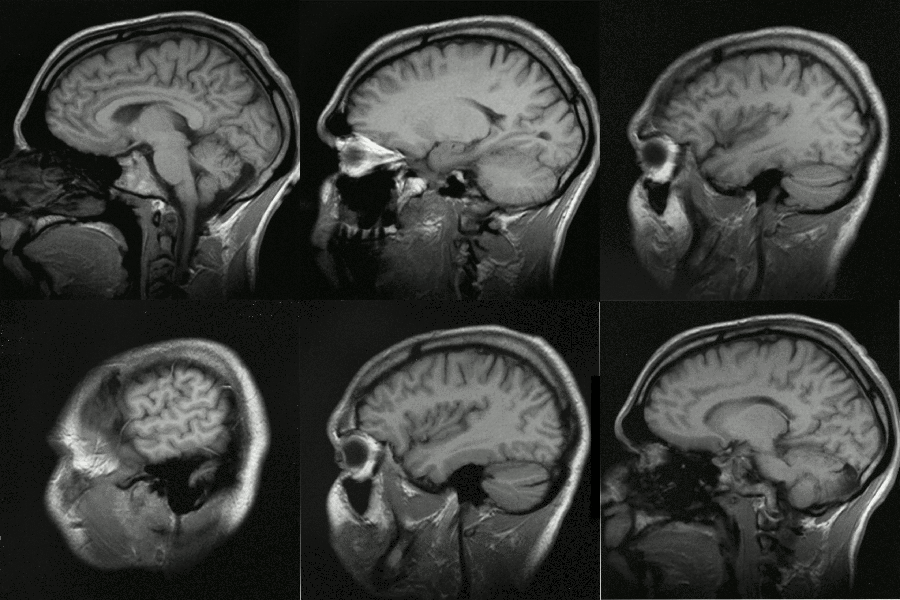
Image: Animated sequence of saggital transections through the human brain.
(from Christian R. Linder, via Wikimedia Commons, [CC BY-SA 3.0])

3.2 Terminal Lucidity and End‑of‑Life Visions
Time scale: Documented in hospice care for more than 150 years; new longitudinal studies in 2026.
Keywords: Terminal Lucidity, End‑of‑Life Visions, transitional type.
Some dying patients suddenly regain clarity or report visions of relatives or luminous beings.
Religious interpretation:
A transition moment between earthly life and spiritual existence.
Scientific interpretation:
Possible temporary restoration of neural networks or changes in oxygen levels.
Hospice studies show that cultural background strongly shapes the content of visions.
Cause–Effect Example
Reduced oxygen → altered perception → symbolic imagery → interpreted as divine encounter.
4. Charismatic Observations
Modern Claims of Divine Status.
4.1 Individuals Claiming Divine Authority
(Global, 2026)
Time scale: Continuous; documented in sociology and psychology.
Keywords: Claiming Divine Status, charismatic type.
Some individuals claim to be divine or chosen by a divine force.
Followers often report visions or emotional experiences around these leaders.
Religious interpretation:
A new prophet or spiritual guide.
Scientific interpretation:
Charismatic influence, group psychology, and social reinforcement.
Studies in 2024–2026 show that strong group identity increases acceptance of extraordinary claims.
Cause–Effect Example
Charismatic leader → emotional group environment → shared experiences → belief in divine status.
5. Five Types of Alleged Divine Observations
| Type of Observation | Example | Source of Experience | Religious View | Scientific View |
| Visionary | Sievernich Apparitions | Single visionary | Divine message | Cognitive/perceptual process. |
| Institutional Vision | Vatican Vision | Single visionary | Prophetic insight | Imagination + prior knowledge. |
| Experiential | NDEs | Medical crisis | Afterlife contact | Neurobiology under stress. |
| Transitional | End‑of‑Life Visions | Hospice patients | Spiritual transition | Oxygen deprivation + cultural imagery. |
| Charismatic | Modern Divine Claimants | Social groups | Spiritual authority | Group psychology. |
Table A: Comparison of five types of alleged divine observations.
6. Religion vs. Science
Two Ways of Understanding God:
Religion seeks meaning, purpose, and moral guidance.
It interprets unusual experiences as part of a larger spiritual story.
Science seeks measurable, repeatable evidence.
It explains unusual experiences through natural laws.
Both perspectives help us understand human experience.
Both perspectives encourage curiosity about life and nature.
7. Summary and Challenge
You explored five recent clusters of alleged divine phenomena.
You learned how Religion and Science interpret them differently.
You saw how visionary, experiential, institutional, and charismatic observations fit into clear categories.
Thank you for reading this article with such attention.
Your curiosity is a strength that will enlighten your wisdom.
References
Ongoing Apparitions at Sievernich, Vatican event. (Germany, 2000–2026):
https://nuntiatoria.org/2026/09/18/the-visions-have-not-stopped/.
Near‑Death Experiences as Evidence of Transcendent Consciousness (Medical Studies, 2026):
https://spiritualevidencemap.com/research/spiritual-evidence-overview.
Terminal Lucidity and End‑of‑Life Visions (Hospice Studies, 2026):
https://spiritualevidencemap.com/research/spiritual-evidence-overview.
Modern Individuals Claiming Divine Status (Global, 2026):
https://brewminate.com/modern-god-claimants-cult-leaders-divine-authority/.