
How Should Our Future God Be?
A thought experiment for spiritual researchers.
Introduction
Imagine that humanity could design a future God.
What qualities would we choose? Would we want a God that is powerful but not loving?
Would we want a God that is wise but unable to communicate? Most people would probably answer "no".
This question combines philosophy, ethics, psychology, biology, and environmental science. It encourages us to think deeply about the values that help life flourish.
It also helps us reflect on the kind of future we want for humanity and for nature.
Asking the Big Questions
Before reading further, ask yourself:
What qualities should a perfect God possess?
Which moral values are most important for you and your friends?
Should a God care about humans only, or about all life?
Should a God protect nature (flora and fauna) with regard to biodiversity and ecosystems?
Should a God encourage curious learning and trustworthy discovery?
What crucial responsibilities come with great power?
There are no simple answers. However, history shows that many cultures have admired similar qualities.
General qualities of a fulfilling religious life
Mankind expects helpful qualities from a higher being, both physical and moral, that enable the survival of humanity and nature, and thus bring happiness.
The main qualities many social people hope to find in a spiritual or religious belief system, are:
1. Love ❤️
Description
Love is the desire to support the well-being of others and to feel happy doing so.
A God without love could become indifferent.
A loving God would care about people, animals, and livable ecosystems.
Cause and effect in social groups
Love → Cooperation → Strong communities → Greater well-being of the individual as well as the group.
Modern psychology shows that supportive relationships improve mental and physical health. Studies over many decades have consistently linked social connection to happiness and longer life.
Example
After natural disasters, communities often recover faster when neighbours help one another out of loving friendship.
Love and CompassionHow do Love and Compassion relate to each other? Love is a deep feeling of connection, appreciation, care, and commitment toward someone or something. One way to see their relationship is: Examples:
In a concise formulation: Thus, compassion can be viewed as a specialised form or expression of love, especially directed toward relieving pain, while love itself encompasses a wider range of positive feelings and intentions, including appreciation, joy, loyalty, and the desire for growth and well-being. And of course, to guarantee natural reproduction and successful childcare, love between man and woman is necessary. |
2. Wisdom 🦉
Description
Wisdom is the ability to use knowledge in a responsible and ethical way.
Knowledge alone is not enough. Humanity can split atoms and edit genes. Yet wisdom helps us decide when and how such powers should be used.
Cause and effect
Knowledge + Reflection → Wise decisions → Better futures.
Historical example
Scientific methods developed between the 1500s and today have greatly improved medicine, agriculture, and technology. Wise use of these discoveries has saved millions of lives.
3. Unity 🤝
Description
Unity is cooperation among different individuals, groups or countries.
It begins with striving for unification and ends in respectful union.
Nature provides many examples. Cells cooperate within your body. Bees cooperate within colonies. Humans cooperate within societies.
Cause and effect
Unity → Shared effort → Greater achievements.
Example
International cooperation helped scientists sequence the human genome between 1990 and 2003. This project improved our understanding of health and disease.
4. Power (Omnipotence) ⚡
Omnipotence means unlimited power.
Description
Power is the capacity to exert strength, to apply force, to influence events, for example by authority, in order to produce desired effects or outcomes.
In its ultimate form, power becomes omnipotence, which is the possession of unlimited power (such as unrestricted ability and absolute control by a deity).
Power can create great good. However, power without wisdom or love can be dangerous.
Most people would prefer a God whose power is guided by compassion, fairness, and responsibility.
Comparison
| Power Alone | Power with Wisdom (and Love) |
| Can dominate | Can protect |
| Can destroy | Can create |
| Can force obedience | Can encourage growth |
| Can cause fear | Can inspire trust |
Table A: Comparison between power in itself, and power in combination with wisdom.
5. Happiness and Success 😊
Description
Happiness is a state of pleasant well-being.
Success is achieving desired or meaningful goals.
Research in positive psychology suggests that lasting happiness often comes from purpose, relationships, learning, and contribution to others.
A desirable God would help life flourish rather than merely survive.
Example
People who volunteer often report greater life satisfaction than people who focus only on personal gain.
6. Survival and Reproduction 🌱
Description
Survival and Reproduction are fundamental biological processes that allow organisms to continue existing as a species.
Every living species on Earth descends from organisms that survived and reproduced over billions of years.
Scientists estimate that life has existed on Earth for about 3.5 to 4 billion years.
A future God concerned with life would value rich biodiversity and healthy ecosystems.
Cause and effect
Healthy ecosystems → Stable food webs → Greater survival of life in general.
7. Communication 📡
Description
Communication is the bi-directional exchange of information.
Without communication, learning becomes difficult. Cooperation becomes weak.
Human communication evolved from speech to writing, printing, radio, television, and the internet.
Timeline of Human Communication
Speech
↓
Writing (~5,000 years ago)
↓
Printing Press (1440s)
↓
Telegraph (1830s-1840s)
↓
Internet (Late 20th Century)
↓
Global Digital Communication Today.
A wise God might encourage clear communication, honesty, and understanding.
8. Energy ☀️
Description
Energy is the ability to do work and produce change.
All life on Earth depends ultimately on energy from the Sun.
Plants capture solar energy through photosynthesis. Animals depend directly or indirectly on plants.
Cause and effect
Solar Energy → Plants → Food → Animals and Humans → Civilisation.
Modern renewable technologies such as solar panels and wind farms are examples of humanity learning to use Earth's natural energy flows more efficiently.
The Ideal Future God
A possible path to enlightenment for human society, would be:
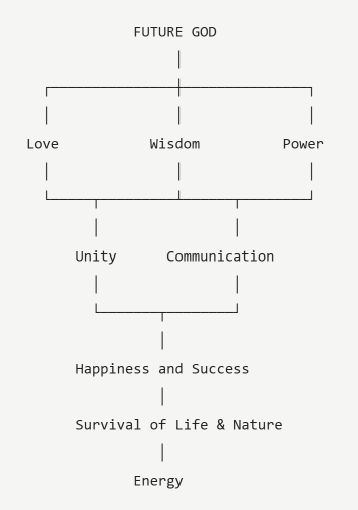
Image A: Paths towards the ideal God.
How would you draw the path to creation of divinity?
Conclusion
If humanity could imagine an ideal future God, many people would likely choose similar qualities:
Love, Wisdom, Unity, Responsible Power, Happiness, Success, Protection and continuation of Life, Communication, and Energy.
These qualities are not only religious ideas. They also appear in psychology, biology, environmental science, and ethics. Together they encourage cooperation, learning, and respect for nature.
Perhaps the most important question is not only "What should God be like?" but also "Which of these qualities can we develop within ourselves?"
Well done for reading to the end. Curiosity and careful thinking are important scientific and philosophical skills.
Think Further
If intelligence, knowledge, and technology continue to grow over the next centuries, which quality will become most important: Love, Wisdom, Power, or Unity?
What would you choose when considering how it could influence the future of humanity and nature?
Which qualities of life -in general- do you find most important?
Sources
Darwin, C. (1859). On the Origin of Species. London: John Murray.
Seligman, M. E. P. (2011). Flourish. Free Press.
Harari, Y. N. (2015). Sapiens: A Brief History of Humankind. Harper.
National Aeronautics and Space Administration (NASA). (2026). Science and Earth observations.
Retrieved from https://www.nasa.gov
United Nations Environment Programme (UNEP). (2026). Biodiversity and ecosystem protection.
Retrieved from https://www.unep.org
World Health Organization (WHO). (2026). Social connections and health.
Retrieved from https://www.who.int
National Human Genome Research Institute. Human Genome Project overview.
Retrieved from https://www.genome.gov/human-genome-project
Intergovernmental Panel on Climate Change (IPCC). (2023). Synthesis Report.
Retrieved from https://www.ipcc.ch/report/ar6/syr/
Nature and biodiversity:
https://www.biodiversitylibrary.org